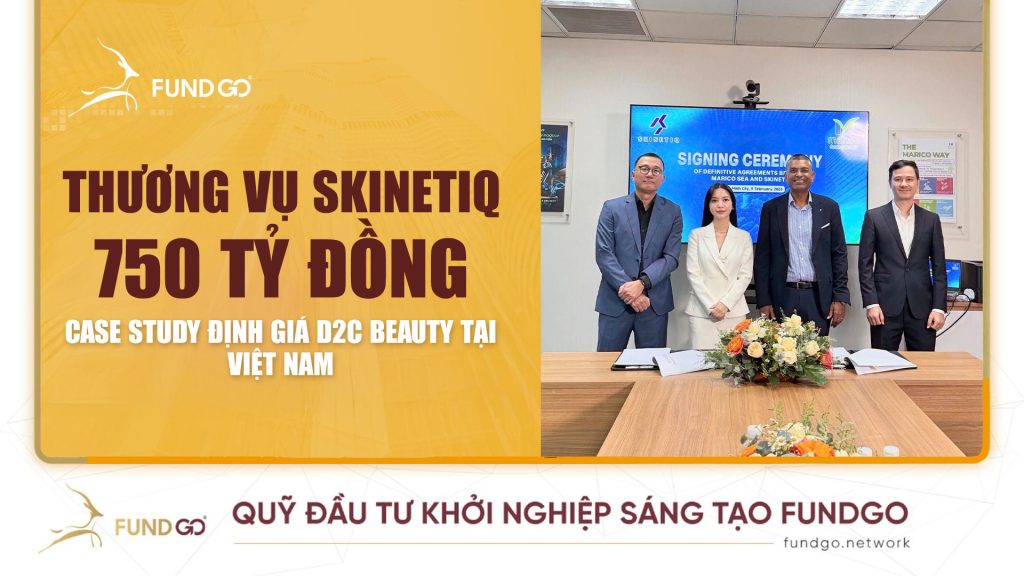
Skinetiq's 750 billion VND deal: A thought-provoking case study on D2C beauty valuation in Vietnam.
12/02/2026
The Vietnamese M&A market has just seen another deal significant enough to prompt investors and D2C founders to pause and analyze: Indian conglomerate Marico Limited spent approximately VND 750 billion to acquire 75% shares of Skinetiq, a company co-founded by Hannah Nguyen. If we interpret the implied valuation, Skinetiq is currently valued at approximately VND 1 trillion.
The crucial question isn't whether it's "expensive or cheap" based on subjective feelings, but rather: Is this valuation reasonable according to financial metrics and the strategic logic of an international FMCG corporation? And more broadly, what does this deal say about how the market is currently valuing D2C (Direct-to-Consumer) models in the beauty industry in Vietnam?
A quick breakdown of the valuation problem: What are EV/EBITDA and P/E ratios telling us?
Based on widely reported media information, Skinetiq's most recent annual revenue was approximately VND 430–450 billion, with a pre-tax profit margin of over 20%, resulting in an estimated EBITDA of around VND 90–110 billion.
If we take an average EBITDA of 100 billion VND, with an implied valuation of 1 trillion VND, we can envision a relatively "clean" picture in terms of valuation: EV/EBITDA is approximately 10 times, while the assumed P/E ratio is around 11–13 times (depending on cost structure, depreciation, taxes, and reinvestment levels). This isn't a "bargain," but it's not exactly an "overvalued" company either—especially when considered in the context of a business with good growth, high profit margins, a D2C model, and a clear brand advantage.
For many traditional FMCG companies, a P/E ratio of 10–15 is quite common; however, for fast-growing D2C businesses with control over their distribution channels, a range of 12–18 is often considered acceptable if the growth story is sound. In other words, from a purely financial perspective, this deal makes sense.
“"True value" lies not just in revenue and profit: D2C is a strategic asset.
If you only look at the revenue of 450 billion and EBITDA of 100 billion, this deal would seem like a typical consumer goods company acquisition. But the reason why large corporations are willing to pay a premium (or at least the "right price") usually lies in the following aspect. intangible assets—things that aren't neatly presented in financial reports, but which determine long-term expansion potential.
With Skinetiq, this core comes from a The D2C ecosystem is relatively complete.D2C combines developing/investing in its own brand with strong distribution capabilities for international brands, while also operating social commerce professionally (especially livestreaming). The valuable aspect of D2C is not just "direct selling," but... owning customer relationships: the business that holds customer file, shopping behavior data, retargeting capabilities, ability to launch new products quickly, and direct distribution channel It can be optimized in real time.
These capabilities, for an international corporation looking to enter Vietnam, are often difficult to acquire simply by "burning money" in the short term—and that's why they choose to... M&A to buy time.
Personal brand: From "media asset" to "valuable asset"“
One aspect that makes the Skinetiq acquisition worth analyzing is the role of personal brand in the growth structure. Hannah Olala (Hannah Nguyen) in this case is not simply a KOL supporting marketing; in the D2C beauty model, a personal brand can simultaneously be... demand generation channel, switching channel, and channel for reinforcing belief—These three functions are extremely expensive if a business has to build from scratch using paid media. Once a sufficiently large community has formed, the cost of recreating “trust + purchasing habits + loyalty” on a comparable scale can be far higher than the figures shown in the profit and loss statements.
So Marico isn't just buying a business; they're buying a growth platform This has proven effective in the local market—which can significantly shorten the learning curve when implementing long-term strategies.
Vietnam is a long-term "reward": 750 billion VND is the entry fee for a well-positioned market.
In the beauty industry, Vietnam is considered a market with many favorable conditions: increasing demand, rapidly expanding e-commerce, booming social commerce, and consumer behavior increasingly driven by content, KOLs/KOCs, reviews, and livestreams. For a corporation like Marico, the 750 billion VND investment is not just about acquiring Skinetiq, but also about... purchase market entry rights In an established position: having channels, data, an operations team, commercialization capabilities, and a brand.
Viewed this way, the deal is like a "ticket" to enter the game with an initial advantage, rather than starting from scratch and accepting the risks of a prolonged implementation.
Comparing its pricing to regional benchmarks: Skinetiq is in the "reasonable zone".“
Compared to other D2C beauty deals in Southeast Asia, the valuation range typically revolves around... 2–4 times revenue or 8–15 times EBITDA, depending on growth rate, profit quality, and channel control level. With Skinetiq, the implied level is approximately... 2.2 times revenue and ~10 times EBITDA This places the deal in relatively “acceptable” territory—there are no clear signs of inflation if the financial assumptions are correct.
This also reveals a reality: the market is paying a higher price for businesses. not just selling products, which are sold by system (channel + data + community + operational capacity).
Marico's perspective: M&A for expansion, optimization, and replication of the business model.
Marico South-East Asia Corporation (or the regional Marico group) often goes beyond simply being a "financial investor" in many transactions. When an FMCG group gets involved, they can bring in operational leverage such as optimizing the supply chain, raising management standards, expanding the portfolio, boosting offline distribution, and even exporting back if they find a suitable product. It's worth noting that if they believe revenue can increase from around 450 billion to 700-800 billion in a few years, then today's 1 trillion valuation may seem "cheap" in the long run—because the value of an M&A sometimes lies in a future scenario where the buyer has a better chance of realizing the deal than the seller.
A major lesson for founders and investors: D2C, when done correctly, can create a real premium.
This deal offers a few clear lessons:
(1) D2C, if operated effectively, can generate high profit margin and grow faster compared to a model that relies entirely on intermediaries;
(2) Personal branding is more than just communication—it can transform into market capitalization if closely tied to the sales system and trust;
(3) Data, community, and direct distribution channels are intangible assets, but valuation, especially when the buyer is a corporation looking to "buy time";
(4) International corporations are willing to pay a good price for a proven traction ecosystem, as it reduces deployment risk and shortens the path to market share.
Conclusion: The 750 billion VND Skinetiq deal is an M&A case study with sound financial foundations and strategic logic.
Skinetiq's 750 billion VND deal, if viewed in its true nature, is a case study on D2C beauty valuation, a case study on the power of personal branding when transformed into a system, and also a case study on how to build a business that is ready for exit.
The financial indicators suggest the deal is not unreasonable; it is the strategic value layer—D2C, data, community, channels, and the ability to replicate growth—that makes the valuation compelling in the eyes of a strategic buyer like Marico.
In the early stages of an undemarcated market, the advantage usually lies with the fastest mover. But once the rules of the game begin to be established, market logic changes completely. The advantage no longer belongs to the fastest runner, but to those who can build the infrastructure and control the risks.
Not only through speculation, the multi-million dollar assets of Vietnamese entrepreneurs in the digital asset sector are formed from technology products. Vietnam is currently among the countries with a high level of participation in the digital economy and digital assets in Asia. It is estimated that approximately […]
The collapse of JWR shows that not all platforms claiming to be "gold investments" are based on the same value foundation. When comparing JWR and HanaGold within the same frame of reference, the differences become clear, stemming from the nature of the product, the risk management mechanism, and so on.
The recent collapse of the JWR gold investment app in China has become one of the biggest shockwaves for the region's financial markets. With estimated losses exceeding 10 billion yuan, equivalent to approximately $1.4 billion, […]
In recent years, Real World Assets (RWA) has been seen as a new approach to applying technology to asset management, cash flow transparency, and optimizing capital connectivity. Globally, many independent studies have noted the growth rate […]
In the digital transformation of the financial and business markets, many organizations worldwide are seeking models that make physical assets transparent, easy to track, and convenient for governance and capital management. Among them, RWA (Real World Assets) stands out...
In the period 2024–2035, digitizing data related to assets, benefits and cash flows in a verifiable, automated and risk-controlled way is considered the direction many organizations in the world are researching. However, not all models “bring data […]
In the global capital market structure, the typical recurring cash flow asset group, bonds, is often considered the stable foundation of many portfolios. In Vietnam, after a period of rapid growth and then strong adjustment, the need for “transparency – standardization – number […]
Creative innovation is entering an era where the core value lies not only in the original work, but also in the exploitation rights that can be extended over time and space. From music, movies, fictional characters to images, designs, content […]
The F&B (Food & Beverage) industry in Vietnam is growing strongly, with an estimated scale of tens of billions of USD per year with a large number of stores, brands and franchise models. Along with the opportunities are familiar "bottlenecks": capital needs for expansion, operating costs […]